
The Balance Between Freedom and Structure

"Flying Freely" – 2024
White Pelican (Pelecanus erythrorynchos)
Montana
The Two Forces of Progress
Freedom and structure exist in constant interaction. One expands possibility, an the other provides direction. Together they create the rhythm of progress in work, relationships, and personal growth.
Throughout a professional life, structure dominates. It brings reliability, efficiency, and accountability. Yet when the formal responsibilities begin to fade, an opposite force awakens…the desire for freedom. This tension, if misunderstood, can create restlessness. But when understood, it becomes the foundation for renewal.
True balance does not mean equal measure. It means integration, freedom guided by principle and structure animated by creativity.
When Structure Becomes Limitation
Structure gives meaning to purpose, but when held too tightly, it limits imagination. For many professionals, structure becomes identity, the schedule, the systems, the responsibilities. When those dissolve, it can feel as if certainty itself has vanished.
What often appears as a loss of control is, in truth, an invitation to rediscover agency. Freedom requires courage because it replaces direction imposed from outside with intention arising from within. The goal is not to abandon structure, but to design a new one that reflects your ongoing personal development in this next great phase of your life.
This is not the absence of order; it is the evolution of it.
Freedom Misunderstood
Freedom is often romanticized as limitless possibility, but unbounded freedom quickly turns into aimlessness. Without direction, even opportunity becomes overwhelming. The paradox is that freedom flourishes only when given a framework.
To live freely means to choose consciously, to set boundaries that protect what matters most, and to define priorities that align with values. Freedom is not an escape; it is expression. It requires clarity, purpose, and responsibility.
Professionals in transition often discover that too much freedom too quickly feels disorienting. The remedy is not restriction, but rhythm, periods of exploration balanced with structure that supports progress.
Designing a New Framework
The framework that supported a full career cannot simply be replicated, it must be redesigned. Instead of external deadlines, new structures may come from personal goals, creative projects, or commitments that give shape to days.
The most sustainable structures are self-chosen. They honor autonomy while maintaining accountability. A daily rhythm, even a modest one, provides continuity that keeps purpose active. Reflection, writing, mentoring, or service can all serve as anchors of intention.
Structure at this stage is no longer about control; it is about coherence. It provides stability without confinement.
Freedom as Responsibility
Freedom without responsibility can feel empty. The measure of mature freedom is not how little you must answer to, but how intentionally you respond. Freedom, in its highest form, invites stewardship of time, talent, and energy.
When freedom is guided by purpose, it integrates an element of generosity. It infuses contribution into your personal fulfillment. The more consciously you use freedom, the more meaningful it becomes.
Responsibility transforms freedom from indulgence into integrity. It redefines achievement not as accumulation, but as alignment.
The Harmony of Balance
Balance between freedom and structure is not a fixed point; it is a living practice. Some days require discipline, others spontaneity. What matters is awareness, the ability to sense which is needed and when.
Too much structure dulls vitality; too much freedom erodes focus. Balance exists in motion, a dynamic equilibrium that keeps life both purposeful and open. When that balance is achieved, life regains flow, effort feels natural, and progress feels peaceful.
The goal is not to choose between freedom and structure, but to let each inform the other.
From Obligation to Intention
In the earlier phases of life, structure often originates from obligation, professional standards, external expectations, or cultural norms. In later stages, it must originate to a greater degree, from intention.
Living with intention transforms daily choices into expressions of meaning. You are no longer confined by structure, rather, you are sustained by it. Purpose becomes the thread that connects freedom to fulfillment.
When you build a life around intention rather than obligation, freedom and structure serve you rather than define you, in your ongoing personal development.
PS: Would you like to learn more about how to transition successfully from your career? I provide services to physicians, non-medical credentialed professionals, corporate executives, businessmen and entrepreneurs that are tailored to their specific needs. Click here to request an introductory conversation.
If you would like to learn about another way that I can guide you, check out this brief video that describes my unique online course:
The Practice Transition Course for Physicians. TM
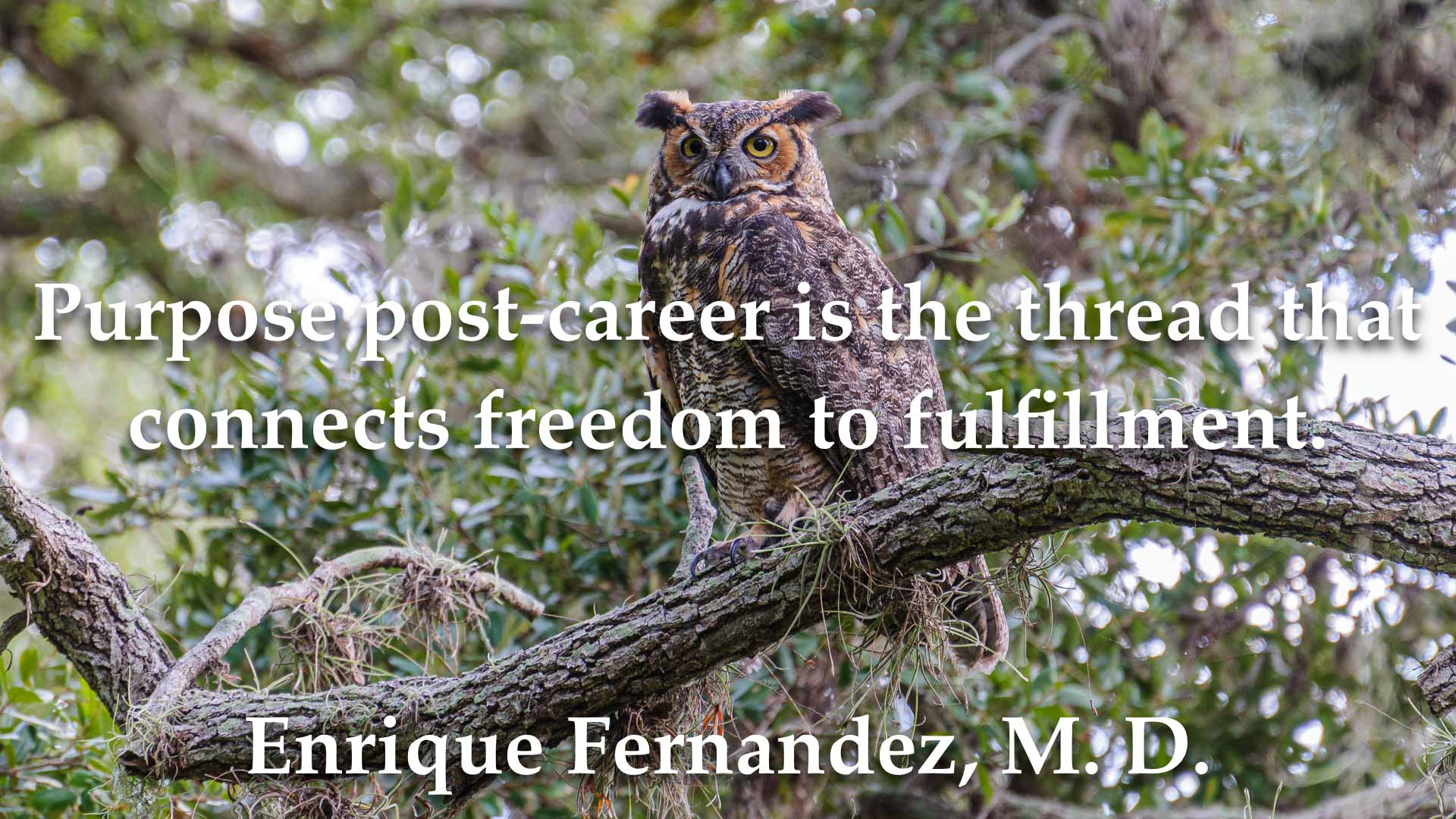 Great Horned Owl (Bubo virginianus) – 2018
Florida

ACCESS FREE GUIDE:
How to Transition Successfully from Your Career -
The Core Concerns
