
When the Title No Longer Defines the Day

Reflections and Evolution – 2011
Georgia, USA
The Question That Follows a Career
The end of a long career changes much more than how you spend your time. For many accomplished professionals, it brings forward a question that may have remained largely unexamined during decades of work:
Who am I now that my professional role has ended?
This is not merely a philosophical question. It can become a deeply personal one.
A career often occupies an enormous portion of adult life. Over decades, your profession may have influenced how others regarded you, how you introduced yourself, where you belonged, how your days were structured, and even how you came to think about yourself.
When that role ends, the resulting absence can be surprisingly profound. The title remains part of your history, but it no longer describes your daily life. The responsibilities that once demanded your attention diminish. Recognition may become less frequent. The familiar rhythms of work disappear.
It can feel as though something essential has been lost.
But perhaps the more useful question is not, What have I lost?
Perhaps it is, What remains?
The answer begins with recognizing that your professional role was never the whole of your identity. It was one important expression of it.
You Were Never Just the Role
For many professionals, a career serves both practical and symbolic purposes. It provides livelihood, structure, accomplishment, recognition, relationships, and a sense of belonging.
Over time, the title itself can become a convenient shorthand for identity.
Physician. Attorney. Professor. Executive. Entrepreneur. Engineer. Leader.
When someone asks what you do, the answer comes easily. The professional title communicates something about education, experience, responsibility, and social role. After decades of using it, the distinction between What you do and Who you are can gradually become less clear.
Yet the qualities that allowed you to fulfill your professional responsibilities existed independently of the title.
Your judgment, discipline, curiosity, perseverance, compassion, creativity, integrity, courage, and other qualities of character were not bestowed upon you by your profession. You brought them to it.
The role gave those qualities a place for expression.
That distinction becomes especially important when the role ends.
Identity, Purpose, and Expression
A professional role can become an important part of your external identity, the persona through which others know you. But beneath that external identity lies something more enduring: your internal identity.
This is Who you are.
Your internal identity is expressed through the qualities of your character. It influences how you understand yourself, how you relate to others, how you make decisions, and how you respond to the circumstances of life.
From Who you are emerges your Why, your sense of purpose.
And from greater clarity about your Who and Why comes the courage to determine your What: the ways you choose to express your character and purpose in the world.
For decades, your career may have provided the principal What of your life. It gave you a structured means of expressing your identity and purpose.
When that career ends, your Who does not disappear. Neither does your Why.
What changes is the form of their expression.
This is why the challenge after a career is not necessarily to find another title as quickly as possible. Doing so can simply replace one external label with another.
The greater opportunity is to determine how the person you have become can be expressed authentically in the circumstances of life that now lie before you.
The Value of the Quiet Period
The period immediately following a long career can feel unfamiliar.
For perhaps the first time in decades, the calendar is not filled by obligations imposed by your profession. Decisions that once demanded immediate attention no longer arrive. Deadlines diminish. Others may no longer depend upon you in quite the same way.
Initially, the resulting quiet may feel uncomfortable.
Yet that quiet has value.
There is no requirement that the next direction become immediately apparent. After decades of responding to external demands, it may take time to hear your own thoughts clearly.
Patience can therefore become an important part of transition.
This is a time for reflection rather than hurried replacement. It is an opportunity to consider what you value now, what continues to stir your curiosity, what you would like to contribute, and what you may have postponed while fulfilling the responsibilities of a demanding career.
Some interests may return from earlier periods of life. Others may emerge unexpectedly. Still others may arise from the knowledge, relationships, and wisdom accumulated during your career.
Creativity often requires space before it finds expression.
Reaffirmation and Redirection
The end of a professional role is not a diminishment of the person who fulfilled it.
It can instead become a period of reaffirmation and redirection.
Reflection allows you to separate the enduring elements of your identity from the temporary structure that surrounded them. In doing so, you may discover that some priorities have changed.
Things that once seemed essential may no longer carry the same importance. Accomplishment may be understood differently. Time itself may acquire greater value. Relationships, creativity, service, learning, mentoring, travel, family, or simply greater freedom to think may assume new significance.
This does not require rejecting the person you were during your career.
Quite the opposite.
It requires understanding that person more fully.
The objective is not to abandon the past but to integrate it into a broader understanding of yourself.
Your Past Remains Part of Your Future
Nothing about the end of a career erases the value of what came before it.
The work was real. The accomplishments were real. So were the challenges, sacrifices, relationships, and contributions.
The individual moments may have been evanescent, but their effects endure in your character, your memories, and often in the lives of the people you served, taught, led, helped, or influenced.
Your career therefore remains part of you without having to define all that you can become.
It was an authentic expression of Who you were and Why you acted.
Now you have the opportunity to ask how those same foundations might find new forms of expression.
That may involve teaching, mentoring, creating, serving, writing, advising, learning, exploring, strengthening relationships, or pursuing interests for which there was previously too little time. The particular activity matters less than its alignment with your character and purpose.
The goal is not simply to remain busy.
It is to remain authentic.
The end of your professional role does not require you to invent another identity. It invites you to understand more clearly the identity that was there all along.
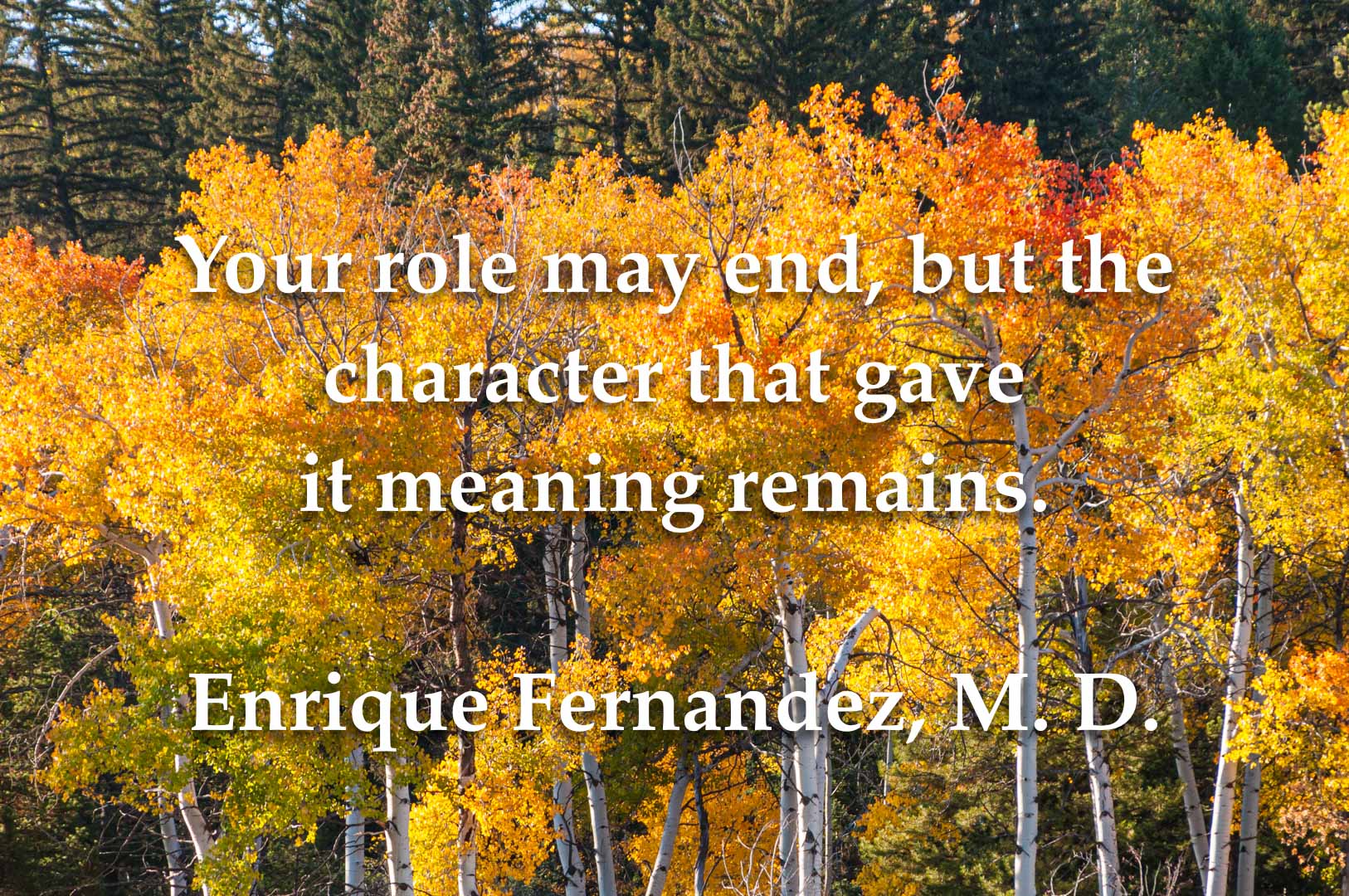
Your role may have ended.
Your capacity to express Who you are has not.
That is one of the great opportunities of this transition: to move forward with greater clarity about yourself, greater freedom in how you express your purpose, and the courage to design the next great phase of your life.
My best wishes for the next great phase of your life!
Clarity. Conviction. Courage ™
Updated: September 11, 2026
PS: Would you like to learn more about how to transition successfully from your career? I provide services to physicians, non-medical credentialed professionals, corporate executives, businessmen and entrepreneurs that are tailored to their specific needs. Click here to request an introductory conversation.
If you would like to learn about another way that I can guide you, check out this brief video that describes my unique online course:
The Practice Transition Course for Physicians. TM
 Rising and Renewal – 2008
Grand Teton National Park, WY

ACCESS FREE GUIDE:
How to Transition Successfully from Your Career -
The Core Concerns
