
The Strength of Stillness

“Strength and Stillness” – 2022
El Capitan
Yosemite National Park
The Misunderstanding of Stillness
In a culture that celebrates motion, stillness is often misunderstood. It is seen as inactivity, passivity, or even weakness. For professionals whose identities have long been tied to action and achievement, stillness can feel unnatural, like losing momentum. Yet stillness is not the absence of progress; it is its foundation.
Stillness allows thought to settle, emotion to balance, and intuition to surface. It gives the mind time to synthesize experience and the heart time to realign with purpose. Without it, motion becomes mechanical and effort loses focus.
Stillness is not what happens when everything stops; it is what happens when everything begins to connect.
The Discipline of Pausing
Pausing is a discipline, not an indulgence. It requires courage to interrupt momentum and attention to create presence. Many professionals resist pausing because they equate productivity with fulfillment of purpose. Yet the pause is what transforms reaction into response, the fog of haste into clarity.
In moments of uncertainty or fatigue, pausing prevents impulsive action. It creates the space in which wisdom has room to speak.
Stillness allows reflection before decision, perspective before conclusion. It teaches patience, a virtue often undervalued in high-performing lives.
The discipline of pausing is not about slowing down the world; it is about slowing down within it.
Stillness as Strength
Strength is often associated with endurance and persistence, yet true strength includes restraint: the ability to act from intention rather than urgency. Stillness is the practice of that restraint.
It takes strength to resist the pull of constant motion. It takes confidence to sit in silence without rushing to fill it. This kind of strength comes not from control, but from trust that clarity will come, that timing will unfold, and that action will be more effective when grounded in awareness.
Stillness is the strength that steadies leadership, sustains creativity, and renews resilience.
The Science of Stillness
Even biology confirms what philosophy teaches: the body and mind require stillness to function at their best. Periods of rest consolidate memory, regulate emotion, and restore energy. Creativity often follows quiet; insight emerges when noise subsides.
The same principle applies to decision-making. Choices made in haste often repeat mistakes; choices made from reflection create lasting solutions. Stillness engages both thought and intuition, integrating logic with wisdom.
In this sense, stillness is not idle, it is the foundation of creativity, often directed at the expression your purpose.
Finding Stillness In Motion
Stillness does not require isolation. It can be practiced even in motion. Walking without distraction, breathing with awareness, or pausing briefly before a meeting…each is a form of stillness amidst action.
The goal is not to escape activity, but to bring attention to yourself within it. This union of stillness and motion creates flow, where energy moves without resistance and awareness remains constant.
When stillness becomes internal, you can remain calm in chaos, deliberate in pressure, and clear in complexity.
Stillness and Leadership
Leaders who embody stillness radiate steadiness. Their calm presence reassures others even amid uncertainty. They listen before reacting, observe before deciding, and lead with composed conviction.
Stillness in leadership is not passivity; it is presence. It gives teams confidence that decisions arise from thoughtful clarity rather than impulse.
In times of transition, stillness allows leaders to discern direction without being distracted by noise. It becomes a stabilizing force, a reminder that quiet confidence is more persuasive than constant motion.
The Relationship Between Stillness and Creativity
Creativity thrives in quiet. Many of history’s greatest insights, discoveries, and works of art emerged not from relentless effort, but from reflective pause.
Stillness opens mental space for association and imagination. It allows intuition to connect dots that logic alone cannot. The mind, when free from interruption, finds its natural rhythm of creation.
Professionals who cultivate stillness often discover that clarity of thought brings efficiency of action. What once took force now flows with ease.
Stillness does not compete with creativity; it completes it.
The Inner Dimension of Stillness
Stillness is not external silence but internal harmony. It is the state in which thought, emotion, and purpose align.
When the inner world quiets, self-awareness deepens. You become less reactive to circumstance and more responsive to meaning. Decisions arise not from fear or pressure, but from centered conviction.
Stillness invites you to listen: to your intuition, to your environment, and to others. Through listening, empathy grows, and with it connection strengthens.
Inner stillness is the birthplace of wisdom.
Practicing Stillness
Cultivating stillness begins with small, intentional pauses:
- Begin and end the day in silence, even for a minute.
- Step away from devices when thinking deeply.
- Before responding to challenge, breathe once fully.
Each act reclaims awareness from distraction. Stillness is cumulative; each moment practiced expands capacity for clarity and calm.
Over time, these pauses create a rhythm of presence. You move through life not hurriedly, but harmoniously.
Stillness as Renewal
Stillness restores what constant motion depletes. It replenishes focus, rebalances energy, and reawakens appreciation.
Through stillness, you learn that renewal is not found in more effort, but in more awareness. Productivity returns, creativity revives, and purpose strengthens.
In stillness, you remember that progress without peace is incomplete. True achievement requires both momentum and mindfulness.
Stillness gives progress its meaning.
PS: Would you like to learn more about how to transition successfully from your career? I provide services to physicians, non-medical credentialed professionals, corporate executives, businessmen and entrepreneurs that are tailored to their specific needs. Click here to request an introductory conversation.
If you would like to learn about another way that I can guide you, check out this brief video that describes my unique online course:
The Practice Transition Course for Physicians. TM
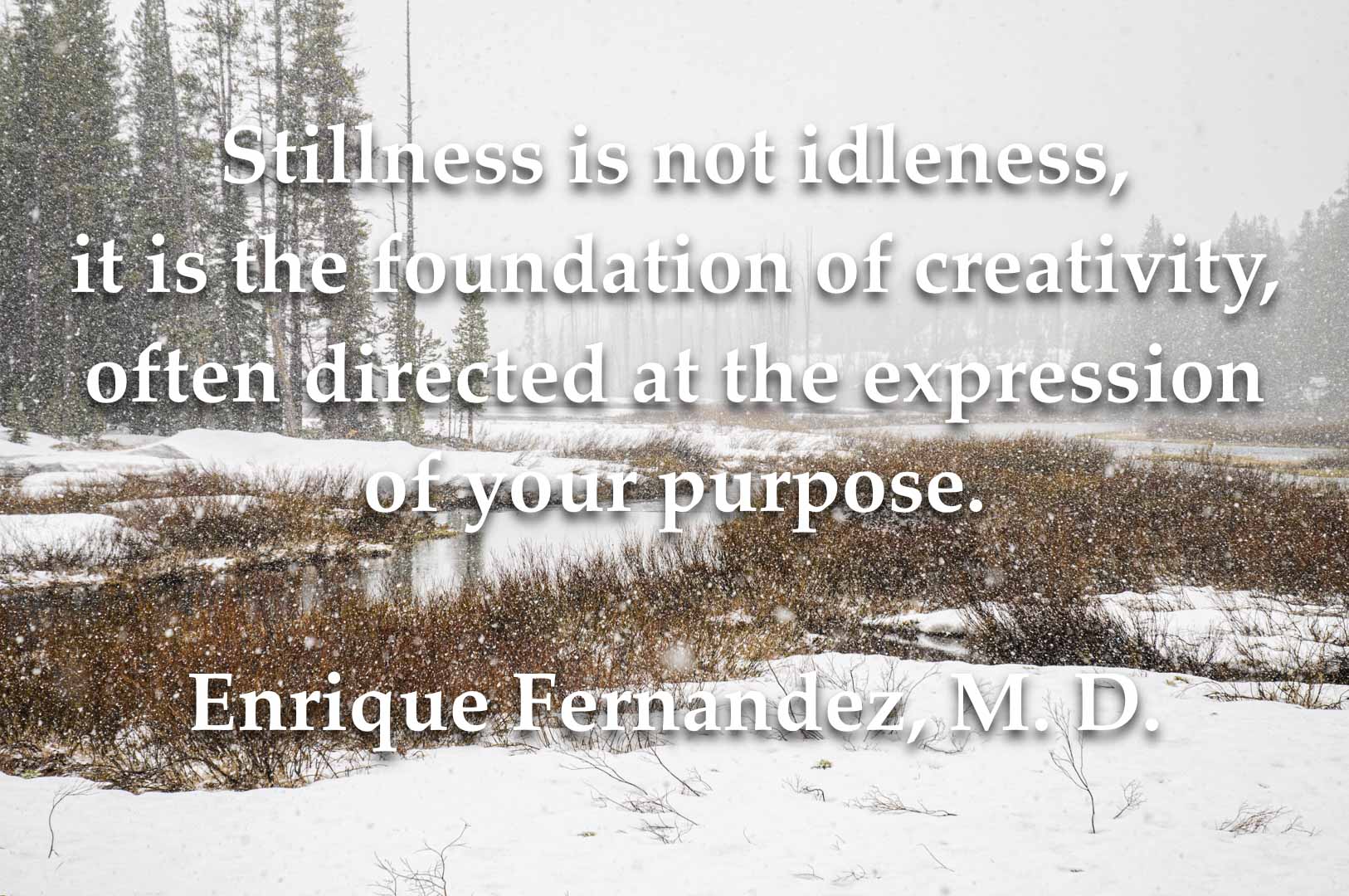 “Shaping Amidst Stillness” – 2010
Lewis River
Yellowstone National Park, WY

ACCESS FREE GUIDE:
How to Transition Successfully from Your Career -
The Core Concerns
